Politics
Kuwait is supposed to be the key to toppling Iran. 2026 says otherwise
A Saudi geopolitical commentator laid out a plan to unite Iranians and finish the Islamic Republic with Gulf money, starting in Kuwait. I checked it against a year in which much of that plan was already tried.

The plan ends with five words. Scare Kuwaitis to unite GCC.
That line closes a page of notes from my interview with a geopolitical commentator from Saudi Arabia. Above it sits a whole theory of how the Islamic Republic ends: what to promise Iranians, which Gulf state opens everyone else’s wallet, and what Washington wants in return. It reads like a war-room whiteboard, and it rests on one bet, the way I wrote it down: if Kuwait pays, the whole Gulf will come in.
I spent the week testing that bet against the record. The problem is that much of it has already been tried.
The experiment already ran
On Feb. 28, the United States and Israel opened a war on Iran whose first strikes killed Supreme Leader Ali Khamenei, The Hill reported. Iran fired back at all six Gulf Cooperation Council states and choked the Strait of Hormuz, and Kuwait took some of the worst of it. Nine months on, the Islamic Republic is still standing, now under Khamenei’s son Mojtaba, whom the Assembly of Experts named supreme leader on March 8, Al Jazeera reported, and a Revolutionary Guard that has not suffered one verified institutional defection.
On Nov. 24, President Trump said toppling the regime is “probably doable” but “was never a criteria for me,” according to Breitbart. The Gulf has paid nothing toward a war the Pentagon puts at $48.3 billion, Al Jazeera reported.
So the commentator’s central question, if Gulf Arabs give you budget and space, will you go finish the regime, isn’t hypothetical anymore. It’s a test with results.
The shopping list
The pitch opens with promises meant to unite Iranians: free stuff, a secure middle-class income, an iPhone for every student, free internet nationwide, zero religious influence, a judiciary that goes, and accountability for what Tehran has done to the region and the world.
The anger underneath is real. In GAMAAN’s June 2026 survey of 31,450 Iranians, 76% named prices, inflation and economic pressure as their top worry. The World Bank projects poverty at 38.4% this year.
But Iranians have lived through the giveaway already. In 2010 Mahmoud Ahmadinejad’s government began paying roughly $40 a person every month, printed money to cover it, and watched inflation eat it alive. With prices up nearly 28-fold since, that payment now buys a few loaves of bread, economist Djavad Salehi-Isfahani writes. Promise free stuff in Iran and people hear 2010.
The iPhone I couldn’t find anywhere. No survey, opposition platform or analyst in everything I went through mentions devices for students as a demand.
Internet is the strongest promise on the list, with one word wrong. After two near-total blackouts this year, Iran got a paid, tiered system where vetted firms and officials get the good connection, per Internet Society Pulse. A quarter of GAMAAN’s respondents said the shutdown cost them their job or main income. Nobody is asking for free. They’re asking for open.
Religion works the same way. About 66% of Iranians in GAMAAN’s 2024 wave opposed rule by religious law, yet in 2022, 56% also rejected an atheist head of state. That’s clerics out of the state, not God out of the country.
The judiciary line lands hardest. Iran executed at least 1,639 people in 2025, the most since 1989, according to Iran Human Rights, and a UN fact-finding mission found January’s crackdown involved crimes against humanity. But scrapping every court collides with the commentator’s own best line: change has to come without shocking a society that has lived its whole life under one system. Iraq’s 2003 purge is the warning; a Jiyan Foundation review of it favors vetting officials one by one on what they actually did.
Accountability to the region is the item most likely to blow a coalition apart. On Nov. 13 the GCC asked the UN Security Council to make Iran pay full compensation for its attacks. Meanwhile 42% of GAMAAN’s respondents call this year’s war “military aggression against Iran.” A broken treasury can’t fund a middle-class income and Gulf reparations at once, and the second is a hard sell to people who see themselves as the ones being bombed.
Where Iranians actually split
The commentator names three fault lines: unity versus Balkanization, religion and sect, and the future system. Two hold up. The future system splits the country, with 34% preferring a monarchy, 28% a republic and 13% the Islamic Republic in GAMAAN’s June wave. Religion barely divides the opposition, since every platform I found promises a secular state.
On territory, the commentator is right that Reza Pahlavi and the regime speak the same language. After five Kurdish parties formed a coalition on Feb. 22, Pahlavi called territorial integrity “the ultimate red line” and denounced “several separatist groups,” AP reported. The main parties on the receiving end mostly don’t talk secession. Komala’s Abdullah Mohtadi calls Iran “the best country for implementing federalism,” he told Rudaw. A smaller current is openly independentist, and nobody has polled Iran’s minorities on it.
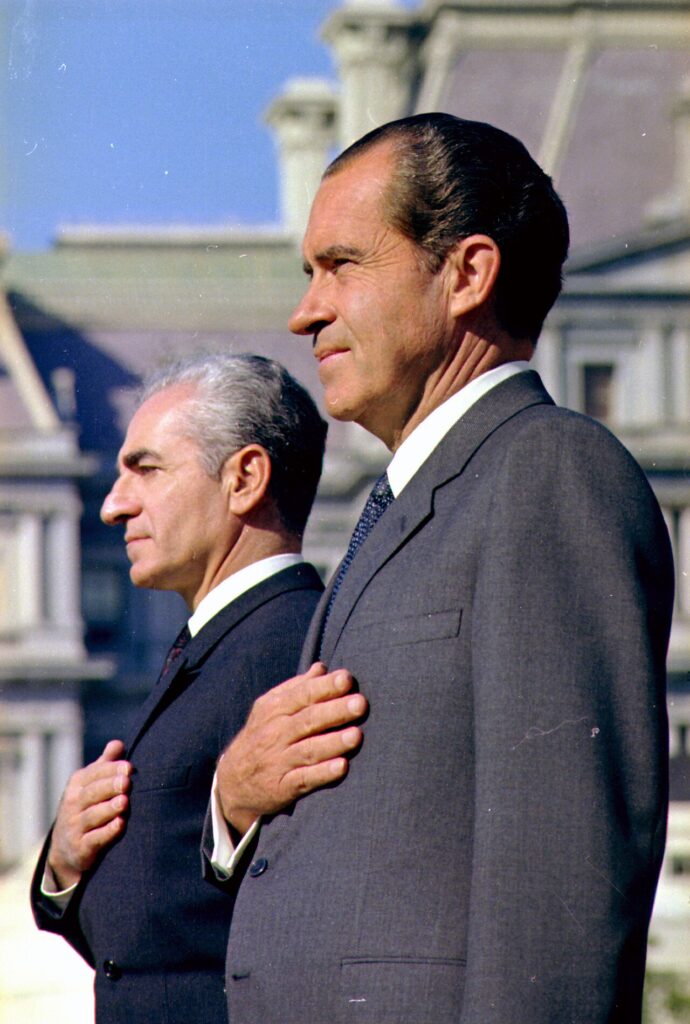
Israel is where the notes get sharp and sloppy at once. Haaretz reported in February that Netanyahu’s government had “fixated on” Pahlavi as Iran’s next ruler. Days after the “separatist” post, Axios reported that the CIA and Mossad were backing those same Kurdish militias, and that the idea of a ground offensive came “initially from Netanyahu and Mossad.” That contradiction is real. A Pahlavi quarrel with Israel is not on the record: this month Pahlavi told an Israeli audience to “finish the job”.
The line that Israel doesn’t work with Sunnis fails, since those Kurdish parties are overwhelmingly Sunni by background. The claim that Baloch and Ahwazi Arabs serve Israel as spies, not militias, holds: ProPublica, citing 10 current and former Israeli intelligence officials, described Mossad recruiting individuals from Iran’s “ethnic and human mosaic.” The only militia arming on record is Kurdish, and it was called off.
Follow the wallet
Now the money. In the commentator’s telling, Kuwait is the unbiased middle state that can open the wallets of the UAE, Saudi Arabia, Bahrain and Qatar, and the result looks like the coalition against Saddam Hussein, this time with Israel inside it.
Kuwait’s middle-state credibility is real; it brokered the end of the 2017-2021 Qatar rift. But it has spent that credibility calming fights, not starting them. Kuwait and Bahrain “have historically followed Saudi foreign policy preferences,” the Soufan Center notes. Kuwait follows. It doesn’t lead.
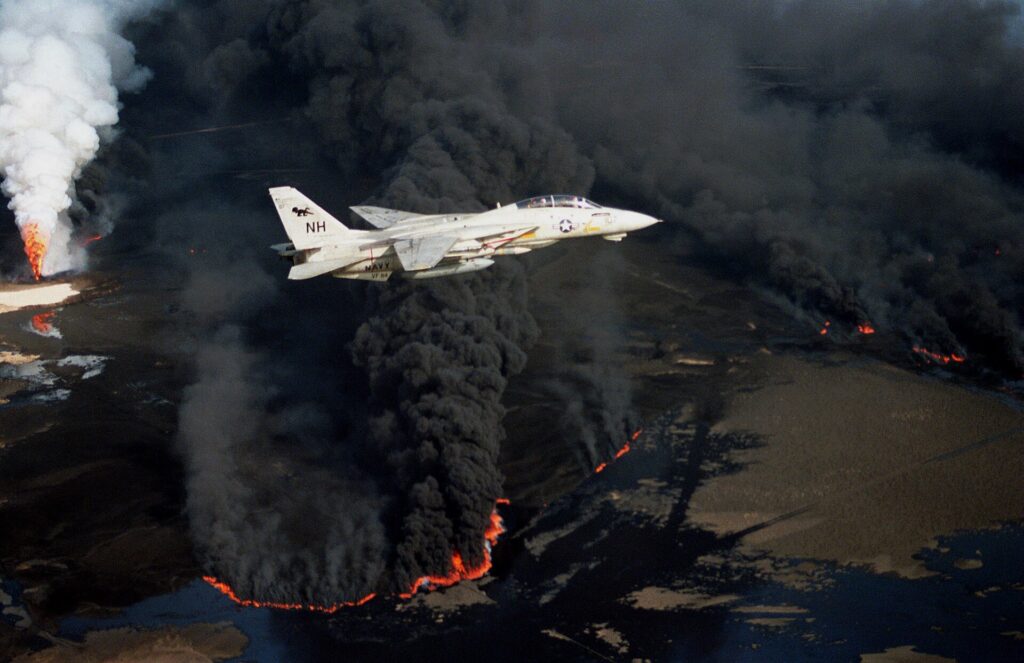
The 1991 precedent runs backward. Allies pledged about $54 billion for the Gulf War, Saudi Arabia and Kuwait around $16 billion each, according to the GAO. That money followed Iraq’s invasion of Kuwait; it didn’t cause the coalition. And Israel was kept out, at Washington’s urging, so Arab partners wouldn’t walk, as Israel’s own foreign ministry recounts. Today Kuwait punishes normalization with Israel with up to 15 years in prison (Washington Institute).
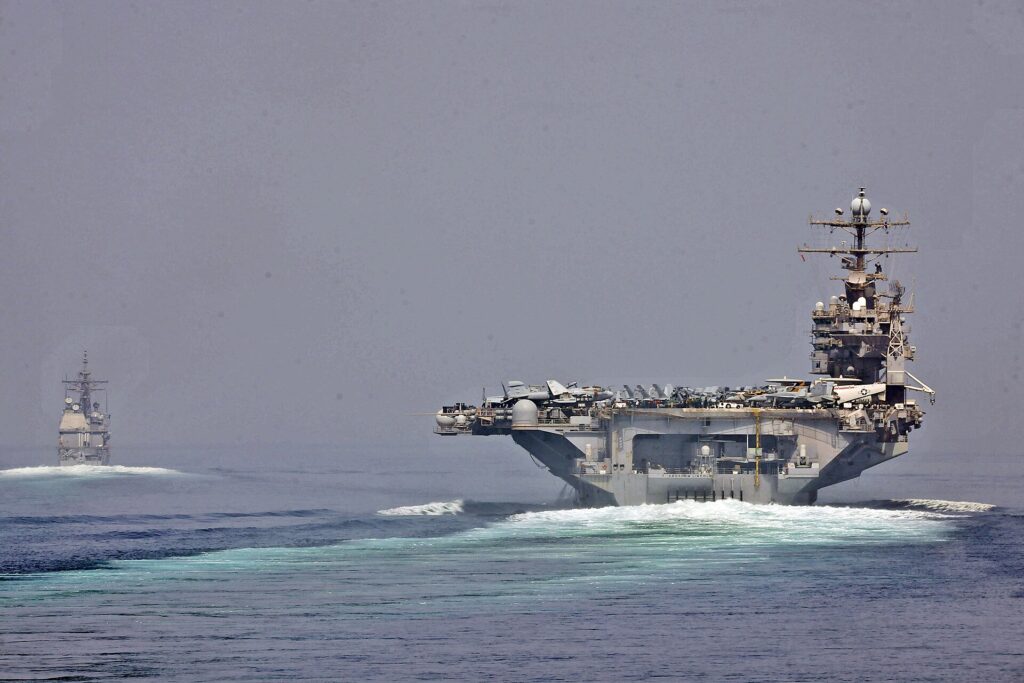
The commentator nails what Washington wants: space and money. Trump said this month that protected countries would “pay us any and all costs we had for the war.” Space gets rationed. Saudi Arabia and the UAE said in January their territory wouldn’t be used to attack Iran, the Washington Times reported. In May, according to Middle East Eye, Saudi Arabia and reportedly Kuwait cut US access to bases and airspace after Trump announced a Hormuz operation called “Project Freedom.” Trump dropped it two days later.
The Emirati open wallet is real, but it opens for Emirati interests, like $35 billion to Egypt. I found no evidence of Gulf money behind regime-change forces or Pahlavi. That’s a blank, not proof. Covert cash doesn’t issue press releases.
Kuwait already got scared
Which brings me back to the last line.
Iran has already done the scaring. Kuwait answered with condemnations, air defense, two expelled Iranian diplomats in June, per the Saudi Gazette, and a summons of Iran’s ambassador on Nov. 27, per Roya News. No war chest. With Hormuz shut, Kuwait has no export route. Carnegie cites an IMF forecast of a 16.7% contraction and notes Kuwait has asked to use Saudi and Emirati pipelines. A frightened Kuwait wants the war over. Carnegie’s word for what the Gulf collectively wants now is “an exit.”
The commentator is right about a different fear: Netanyahu policing the region. After Israel struck Doha on Sept. 9, 2025, the Gulf hardened against Israel. Riyadh has since signed a “Mecca Pact” with Turkey and Pakistan that Carnegie’s authors read as “an implicit rebuke of the UAE and the Abraham Accords.” The UAE is the exception. The commentator’s fix for Israel’s Kurdish mess, working through Arab partners, has nothing behind it. The vetoes on that file sit in Ankara and Washington.
What I don’t know, and what I think
Almost every opinion number here comes from GAMAAN, which recruits through VPNs and likely over-samples connected, urban, angry Iranians while missing loyalists and the offline poor. The Kuwaiti base cutoff rests on thin sourcing. Fresh Iranian strikes could harden Gulf capitals again, though toward degrading Iran’s military, not paying for its overthrow. And my read, which is only a read: a Saudi voice putting Kuwait, not Riyadh, at the center of the money plan may say as much about how Riyadh wants to be seen as about how Kuwait behaves.
Now my side of it, and this part is opinion. The regime doesn’t fall because Kuwait writes a check. It falls when Iranians stop fighting each other long enough for the men with guns to notice. On paper the coalition already exists: about 70% of GAMAAN’s respondents want the Islamic Republic replaced, only 13% still pick it as a system, and 94% sign on to “Long live Iran.” What keeps breaking it is the same two fights: who leads, and whether a Kurd in Mahabad or a Baloch in Zahedan gets a say in how the country is run. The 2023 opposition charter alliance lasted about six weeks, according to a JINSA study. This February’s split took days, and it was over one word: separatist.
The coalition I want to see is wider than any one camp. Monarchists and republicans. Persians, Azeris, Kurds, Lurs, Baloch, Arabs and Turkmen. Believers and secular Iranians. All on one page that promises a referendum, a secular state and an elected assembly to settle the federal question. Nobody at that table has to like everyone else at it. They have to agree the table comes first. That’s the one thing all of 2026’s missiles couldn’t build.
The commentator wanted Kuwait scared. On Friday, Kuwait summoned Iran’s ambassador again.
The fear is there. The wallet is still shut.
Sources
- The Hill: Iran’s interim leadership after Khamenei’s death
- Modern Diplomacy: Kuwait under Iranian fire in the 2026 war
- Al Jazeera: Iran names Mojtaba Khamenei supreme leader, March 8, 2026
- Breitbart: Trump on regime change, Nov. 24, 2026
- Al Jazeera: Trump’s demand that Gulf allies repay war costs
- GAMAAN: June 2026 survey of Iranian attitudes to the protests and war
- GAMAAN: 2024 survey of political preferences
- GAMAAN: 2022 political systems survey
- Kayhan Life: World Bank poverty projection
- Djavad Salehi-Isfahani: Iran’s cash transfers and inflation
- Internet Society Pulse: Iran’s tiered, monetized internet
- Iran Human Rights: 2025 execution figures
- Center for Human Rights in Iran: UN fact-finding mission findings on January 2026
- Jiyan Foundation: Transitional justice lessons from Iraq
- The National: GCC compensation demand at the UN Security Council
- AP via News4Jax: Pahlavi and the Kurdish coalition
- JINSA: Iran’s Kurdish coalition and the future of the opposition
- Rudaw: Interview with Komala’s Abdullah Mohtadi
- Haaretz: Israel’s backing of Pahlavi
- Axios: CIA and Mossad support for Kurdish militias
- Times of Israel: Pahlavi’s “finish the job” remarks
- ProPublica: How Mossad recruited inside Iran
- Soufan Center: Kuwait and Bahrain’s alignment with Saudi policy
- GAO: Allied contributions to the 1990-91 Gulf War
- Israel Ministry of Foreign Affairs: Israel and the 1991 Gulf War
- Washington Institute: Arab anti-normalization laws
- Washington Times: Saudi and UAE airspace position, January 2026
- Middle East Eye: Gulf states and “Project Freedom”
- Bloomberg: Abu Dhabi’s $35 billion Egypt deal
- Semafor: Gulf reaction to Israel’s Doha strike
- Saudi Gazette: Kuwait expels Iranian diplomats
- Roya News: Kuwait summons Iran’s ambassador, Nov. 27, 2026
- Carnegie Endowment: The Gulf’s search for an exit
Photos
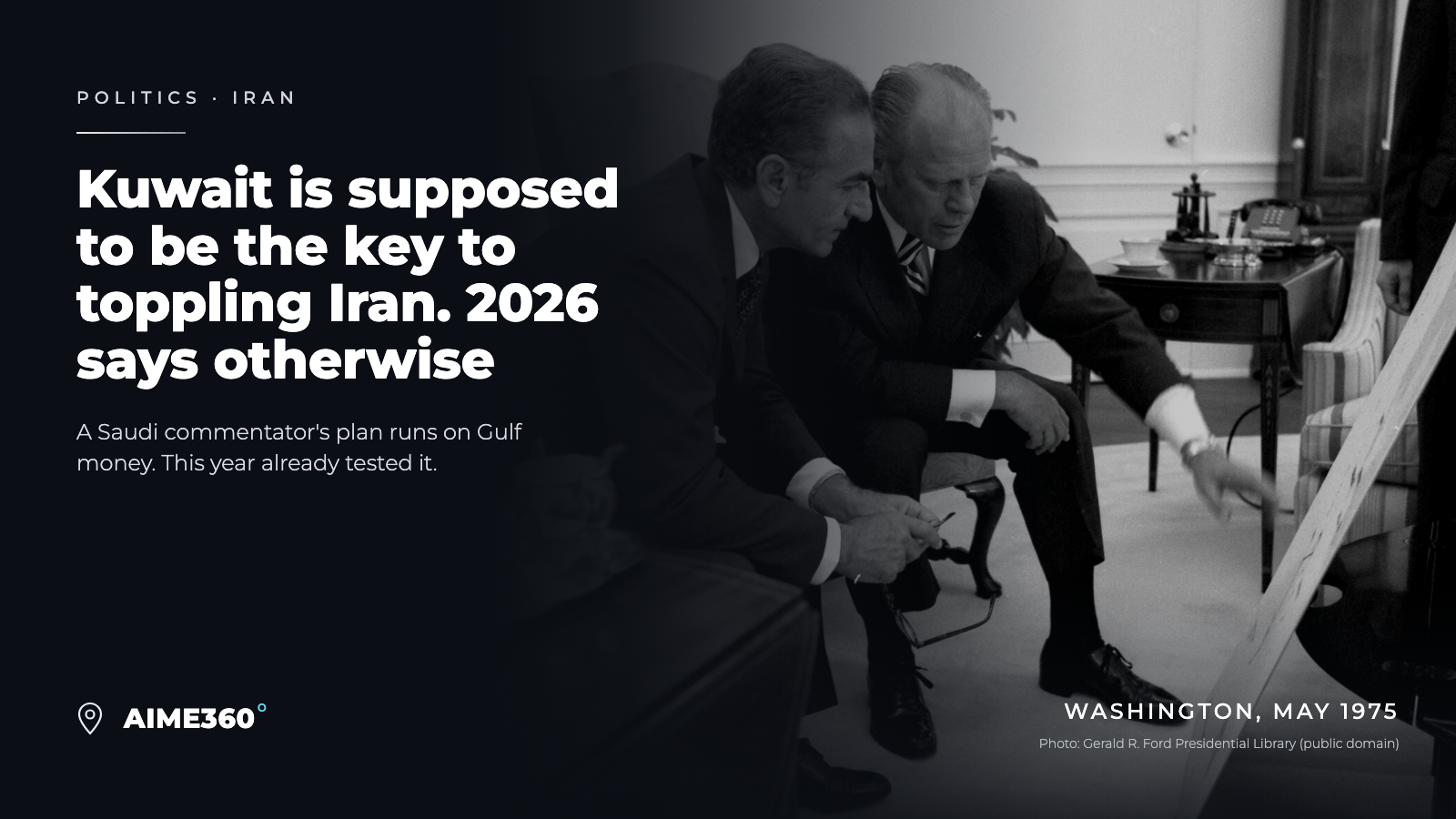
- Featured: President Gerald Ford and Mohammad Reza Pahlavi, May 15, 1975. Gerald R. Ford Presidential Library, public domain, via Wikimedia Commons.
- The Shah of Iran and President Nixon, Oct. 21, 1969. Robert L. Knudsen, National Archives, public domain, via Wikimedia Commons.
- F-14A over a burning Kuwaiti oil well, 1991. Lt. Steve Gozzo, U.S. Navy, public domain, via Wikimedia Commons.
- U.S. Navy ships transit the Strait of Hormuz, May 11, 2012. Alex R. Forster, U.S. Navy, public domain, via Wikimedia Commons.