Politics
The front that nationalized Iran’s oil now meets in living rooms
The National Front put Mohammad Mosaddegh in power in 1951 and beat Britain at the UN and the World Court. In 2026 it has no documented office, no membership count and a chairman born in 1942. We mapped what it has actually done, and where.

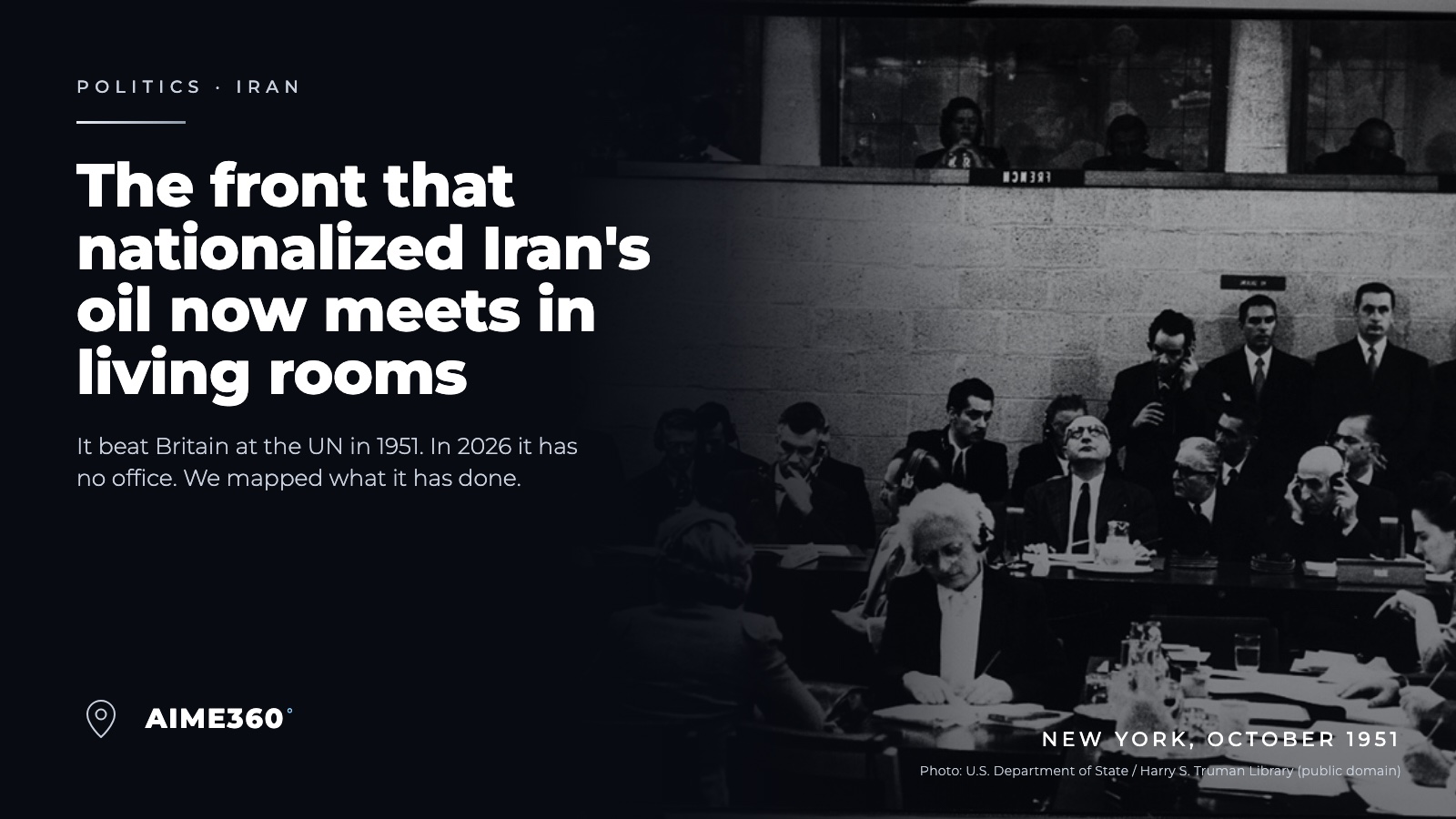
On Oct. 15, 1951, Mohammad Mosaddegh sat at the United Nations Security Council in New York, a pair of translation headphones over his ears, and told the room it had no authority over Iran’s oil. The headphones are in a State Department photograph now held by the Truman Library. The argument is in the U.S. diplomatic record: he walked the Council through Iran’s history with the Anglo-Iranian Oil Company, called Britain’s draft resolution unacceptable, and said Iran was ready to talk about sales and compensation. Four days later the Council adjourned without adopting it.
On Nov. 10, 2026, the organization he founded gathered at Ebn-e Babouyeh cemetery near Tehran to remember his foreign minister, Hossein Fatemi. By the Front’s own account, security forces were present.
That is the distance this story covers. The National Front of Iran, Jebheh Melli, was formed in October 1949 after Mosaddegh led politicians, students and bazaar traders into the royal palace grounds to protest rigged elections, as the historian Ervand Abrahamian describes it. It took power in 1951, nationalized the oil industry, and was overthrown in the coup of Aug. 19, 1953. It came back in 1960, in 1965, in 1977 and again in the 1990s. Each time it was shut down. It is still there, unlicensed, in Tehran.
Why tell this story now? Because the National Front is supposed to be gaining traction in Iran. But is it?
The numbers don’t say so. The only poll that ever named the Front put it at 8.3%, and that was in 2018. Nobody has measured it since. What has grown is the Front’s voice: an election boycott, a demand to rerun the 1979 referendum, a steady run of statements from Tehran. Louder is not the same as bigger. This map is my attempt to tell the two apart.

Seven meetings and a 9-5 ruling
Count what can be counted. The Security Council held seven meetings on Britain’s complaint between Oct. 1 and Oct. 19, 1951. Mosaddegh spent about six weeks in the United States, from New York to Washington to Philadelphia. The following June he argued Iran’s case in person at The Hague, and on July 22, 1952, the International Court of Justice ruled 9 to 5 that it had no jurisdiction. That was Iran’s position. A country most of the world’s press treated as a nuisance had just won on procedure, twice.
The map below starts there. Pick a period, then pick a place.
Abroad: where the name traveled
Documented actions outside Iran, 1951 to 2026. Dot size shows how many entries a place has in the selected period.
Select a dot to see what happened there.
The student protests of 1960 to 1978 were actions of the Confederation of Iranian Students, in which National Front students were one current among several. Diaspora organizations use the Front’s name; the Tehran council has said it has no organization abroad.
One big crowd, then silence
At home the record is thinner than the legend. The Front’s one mass meeting after the coup was at Jalaliyeh in Tehran on May 18, 1961. The scholar H.E. Chehabi puts the crowd at about 80,000 and calls it “the first and last mass meeting of the Second National Front.” Foreign Affairs estimated 70,000 at the time and noted that no further meeting was permitted.
Twenty years later the Front printed four million leaflets for a rally on June 15, 1981, against the new retribution law. The rally never happened. That morning Ayatollah Khomeini settled it in a sentence.
“The ‘National Front’ is condemned as an apostate group from today.”Ayatollah Khomeini, June 15, 1981, in the official English text of Sahifeh-ye Imam
Since 1985, by the account of its current chairman, the council has met in members’ homes. Its last headquarters was seized in July 1980.
At home: Tehran first, everywhere else second
Switch between where the Front had a base, where it is documented today, and what one survey says about republican sentiment. Dots mark documented events.
Select a province or a dot.
The pattern is blunt. Tehran gave the Front five of its eight seats in the 1950 parliament and all 12 of the capital’s seats two years later. Outside Tehran, its footholds were the hometowns of individual leaders: Kashan, Kerman, Sabzevar, Kermanshah. In Tabriz in 1952, its slate lost to the clerical one, and a June 1953 rally there drew about 400 people, according to a U.S. consular report.
Who is still in the room
The chairman is Seyed Hossein Mousavian, born in March 1942. He is not the former nuclear negotiator of the same name. The last internal election anyone can document was on Oct. 29, 2021. The newsletter, Payam-e Jebhe Melli, reached issue 227 in September 2026, which works out to three or four issues a year.
What the Front does now is write. It boycotted the parliamentary vote in February 2024 and the presidential one that June. Its Khorasan branch condemned the crackdown on protesters on Jan. 5, 2026. On Feb. 3, 2026, its Central Council demanded that the 1979 referendum question, “Islamic Republic, yes or no,” be put to Iranians again after 47 years, with a freely elected constituent assembly and an end to the death penalty. It also opposed any foreign military attack.
What the map can’t show
It can’t show popularity, because nobody has measured it by place. The only poll that ever named the Front gave it 8.3% in a hypothetical free election (GAMAAN, 2018, an online survey whose method is contested). In 2022 the same pollster found 64% of respondents viewed Mosaddegh positively, about the same as both Pahlavi shahs. By June 2026, monarchy led a republic 34% to 28%.
It can’t show members. No figure exists for any period. And the strongest case against the Front comes from two directions at once. Iranian state institutes call it elitist and secular. Monarchists point to November 1978, when its leader Karim Sanjabi went to France and aligned the Front with Khomeini. The Front’s reply has not changed: the shah closed every other door.
On Nov. 26, 2026, the day this was written, the Front’s Telegram channel posted a new statement tying defense of the homeland to respect for citizens’ rights. The headphones are in an archive in Missouri. The statements keep coming. Who is listening is the part nobody has counted.
Get the full 61-page ebook
The complete research profile: how the Front was formed, who backed it, who runs it, every source, and 28 archive photographs. Leave your email and we’ll send you the download link.
Sources
- Ervand Abrahamian, Iran Between Two Revolutions (Princeton University Press, 1982): the founding, the social base, seat counts.
- H.E. Chehabi, Iranian Politics and Religious Modernism (Cornell University Press, 1990): the Second Front, Jalaliyeh, the 1980 elections.
- Shaul Bakhash, The Reign of the Ayatollahs: 1978 to 1981.
- Mark Gasiorowski, “Coup d’Etat of 1953,” Encyclopaedia Iranica: the Mosaddegh government and the coup.
- Afshin Matin-Asgari, “Confederation of Iranian Students,” Encyclopaedia Iranica: student opposition abroad.
- Foreign Relations of the United States, 1952–54, vol. X, doc. 114 and 1951–54 Iran, doc. 233: the Security Council session and U.S. consular reports.
- International Court of Justice, Anglo-Iranian Oil Co. case: the order and the judgment.
- Sahifeh-ye Imam, official English text: Khomeini’s speech of June 15, 1981.
- Foreign Affairs, January 1962: the Jalaliyeh crowd estimate.
- GAMAAN surveys: 2018, 2022, 2024, 2026.
- The Front’s own record (not independent): official Telegram channel; Seyed Hossein Mousavian’s account of the organization; notice of the Fatemi commemoration; Central Council statement of Feb. 3, 2026, via Kar-online.
- Iran International on the 2024 boycott; VOA Persian on Ahmadabad, 2019.
Photos
- Mosaddegh at the UN Security Council, about October 1951: Department of State, courtesy Harry S. Truman Library. Public domain.
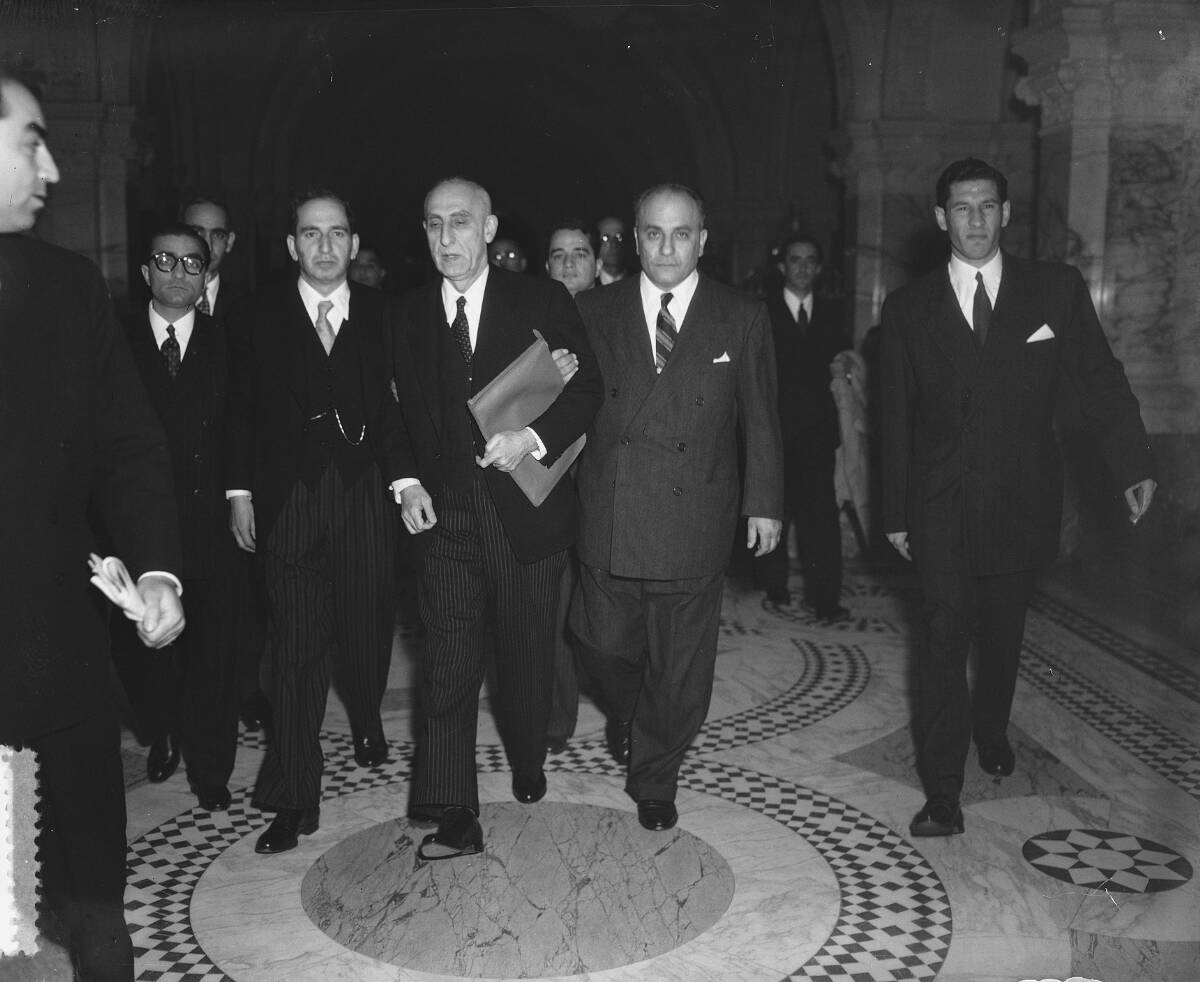
- Mosaddegh arriving at the International Court of Justice, June 9, 1952: Harry Pot / Anefo, Nationaal Archief, The Hague. CC0.
- Maps: AIME 360, from the sources above. Boundaries from the open-source world-atlas and datamaps projects.